

How many organic cotton tote bags do you need? Fewer than you think. Two to four covers most households. More than that and you've rebuilt the drawer of random bags you were trying to get rid of.
Then there's the other question nobody answers on the product page: how do you wash one? Here's both, with the cost math and the care routine. No lecture attached.
Short version: one bag for the car, one for your work or errand bag, and one spare so there's always a clean one while another is drying. Wash them when they're dirty, hand wash in cool water, and air dry. That's it.
How many organic cotton tote bags do you need
Count your regular trips, not your good intentions. A bag only works if it's within reach when you need it.
- One in the car or by the door. This is the one that does the weekly grocery run. If it lives in the trunk, it's there when you park. If it lives in a cupboard, it isn't.
- One in whatever you carry daily. Work bag, backpack, stroller. This is the "I stopped at the store on the way home" bag.
- One spare. Cotton takes a while to dry. A spare means a wash day doesn't send you back to plastic.
A fourth makes sense if you shop at two stores in one trip or carry library books. Beyond that, you're collecting, and that's fine, but it isn't the point.

The cost math
Each of our organic cotton canvas totes is $22.99. Two is $45.98. Four is $91.96. Free shipping starts at $35, so two clears it.
The honest question is how many times you have to use one before it beats a single-use plastic bag. A 2011 life cycle assessment from the UK Environment Agency looked at this for climate impact. It found a cotton bag has to be reused at least 131 times to come out ahead of a standard plastic carrier bag that's only used once. If the plastic bag gets a second life as a bin liner, the cotton bag needs 173 uses.
Two caveats, and the second one matters. The 131 and 173 figures are for climate impact only, from a 2011 UK study. And the cotton bag it tested was not organically grown. On the other measures the study checked, such as acidification and ecotoxicity, the cotton bag still came out worse than plastic in seven of nine categories even at 173 uses, partly because of fertilizer use and the energy it takes to turn cotton into yarn. Organic growing changes the fertilizer part. The study didn't test it, so we won't claim it fixes the rest. What the numbers do say is simple: a cotton bag only makes sense if you use it a lot. Here's what that looks like.
| How often you use it | Time to reach 131 uses | Cost per use at 131 uses |
|---|---|---|
| Once a week | About 2.5 years | About 18 cents |
| Twice a week | About 1.25 years | About 18 cents |
| Daily | About 4 months | About 18 cents |
The cost per use only drops from there. At one trip a week for five years, that's 260 uses and about 9 cents each.
Fine, we'll say it. The organic part doesn't make the bag last longer. Using it does. The listing says GOTS-certified organic cotton from the supplier, which tells you how the cotton was grown and processed. The bag still has to earn its place the boring way, by getting used.
That's also the argument for two bags and not ten. Every extra bag you own is one that has to hit its own 131.
How to wash a cotton canvas tote
To wash an organic cotton canvas tote: pretreat stains, hand wash in a basin with detergent and a soft brush, rinse well, and air dry. Never put it in the dryer.
All four listings say the same thing: pretreat stains if needed, hand wash with warm water and laundry detergent, use a soft brush or cloth, air dry. We're following that because it's what the product page says. We haven't run these particular bags through a machine, so we won't tell you they survive one.
- Empty it and shake it out. Crumbs, receipts and a stray pen live in the bottom corners.
- Pretreat any stain. A dab of laundry detergent or dish soap on the spot, worked in with a soft brush or cloth. Let it sit a few minutes.
- Wash in a basin or sink. Warm water, a little detergent, and a gentle squeeze. The listings say warm. If the bag has a dark color or a print, go cooler, since heat is what fades and shrinks cotton.
- Rinse until the water runs clear. Leftover soap makes the fabric stiff.
- Air dry. Hang it by the handles or lay it flat. Skip the dryer. High heat is the usual way cotton shrinks, and it's a lot of effort to ruin a bag by getting impatient.
If you do use a washing machine, the usual advice for cotton canvas is cool water, a gentle cycle and no dryer. That's general guidance, not a tested claim for these bags. Check the care label on whatever you own.
Skip bleach. It's hard on cotton fibers and on printed designs, and nothing a tote carries calls for it.
How often to wash it
Wash a tote when it looks dirty, smells off, or after anything leaks. Once a month is a fair default. That's more often than most of us do, and the reason is below. A 2011 University of Arizona and Loma Linda University study of reusable shopping bags collected from shoppers in California and Arizona found large numbers of bacteria in almost all of them, coliform bacteria in about half, and E. coli in 8%. The bags were seldom, if ever, washed. When researchers added meat juices to a bag and left it in a warm car trunk for two hours, the bacteria grew about tenfold. Washing, by hand or machine, cut bacteria in the bags by more than 99.9%.
That study was partly funded by the American Chemistry Council, a plastics industry group, and the bags tested weren't ours. Still, the finding that washing works is hard to argue with. Soap and water do the job.
Our rule of thumb, which is practical advice and not from the study: wash it when it looks dirty, when it smells off, and any time something leaked. If you carry raw meat, wash that bag right away or keep one bag only for that. Otherwise, once a month is a fine default.
What a canvas tote shouldn't carry
Canvas isn't waterproof. A dripping package of chicken, a leaking milk carton or a bag of wet produce will soak through and leave the bag damp for a day. Put wet or leaky things in a container first, or bag them separately.
Heavy loads are fine for a 9 oz canvas. The listings say medium-heavy weight with reinforced handles, so groceries and library books are the intended job. A full case of canned tomatoes is a test we haven't run.
When to retire a tote
A good one lasts years. Look at the handle seams first, because that's where the weight sits. If the stitching is pulling away, fix it with a few passes of strong thread, or stop loading it with anything heavy. Holes in the body or a stain that won't shift mean it's time to downgrade it: use it for the garage, the car or hauling shoes.
When it's really done, cut it into rags. It's cotton, and cotton wipes a counter just fine.
Who this doesn't fit
- If you forget bags every time. Leave one in the car and one by the door. A bag in the cupboard doesn't count.
- If you carry a lot of wet or raw items. A cotton bag soaks it up. A wipe-clean bag will do better there.
- If you won't wash it. Be honest with yourself. If it's going to live dirty, a cheaper bag you can toss may suit you better.
- If you already own a pile of free totes. Use those first. The best bag is the one you already have.
Which one to pick
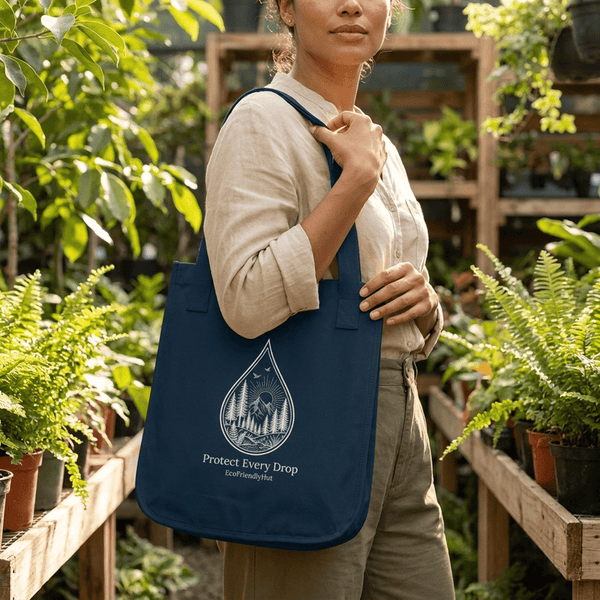
They're all the same bag in different prints, same 9 oz canvas, same price, same GOTS-certified organic cotton blank. Pick the print you'll actually carry.
- Minimal Fern Print: Black, Cream, Camel, Coal or Khaki.
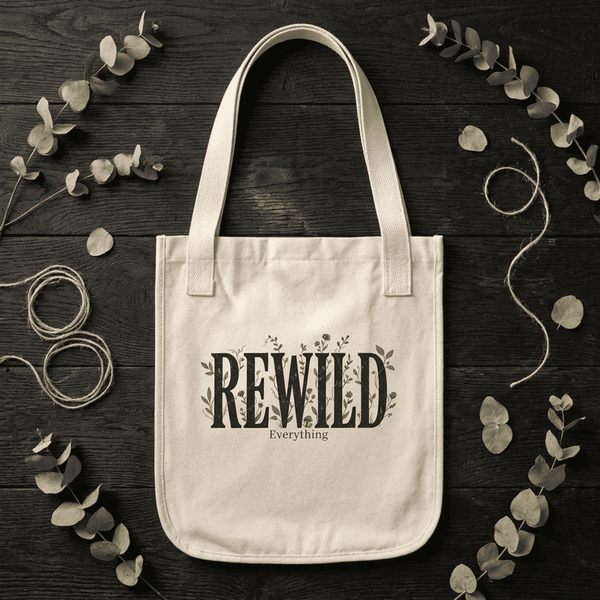
- Rewild Print: Black, Natural or Navy.
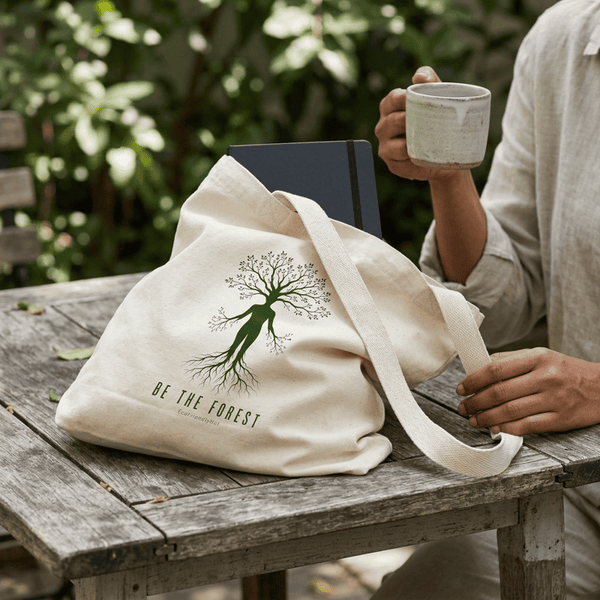
- Forest Print: Black, Natural or Navy.
- Reusable Grocery Tote (pines, mountains and birds): Black, Natural or Navy.
If you want a dark bag for muddy-boot errands, Black or Navy hides a lot. If you want one that shows the dirt and tells you when to wash it, Natural does that job.
Anyway, they're in the Sustainable Lifestyle collection if you want one. Not sure what to swap first? We wrote about picking one swap you'll actually keep.
Curious how many totes other people actually rotate.
Sources: UK Environment Agency, "Life cycle assessment of supermarket carrier bags" (2011) (reuse numbers: 131 times against a plastic bag used once, 173 if the plastic bag is reused as a bin liner); Williams, Gerba, Maxwell and Sinclair, "Assessment of the Potential for Cross-contamination of Food Products by Reusable Shopping Bags," Food Protection Trends, August 2011 (bag bacteria and washing results; partly funded by the American Chemistry Council). Washing steps follow the care instructions on each product listing. Cover photo by Greta Hoffman on Pexels.